
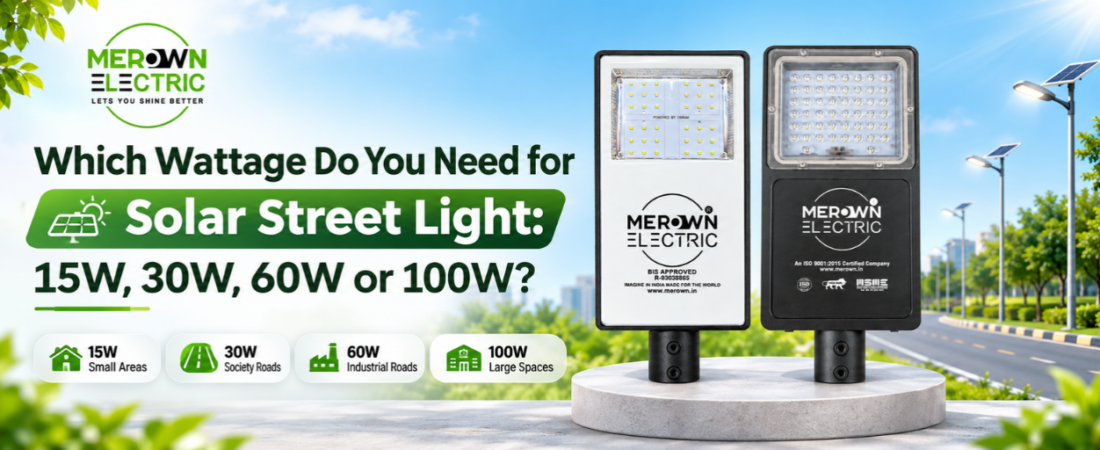
Which Wattage Do You Need for Solar Street Light: 15W, 30W, 60W or 100W?
A practical buying guide to comparing solar street light wattages, understanding technical specifications and choosing the right lighting solution for your project.
Choosing the right solar street light is an important purchasing decision for residential societies, commercial properties, industrial facilities, rural roads and public infrastructure projects. The ideal wattage depends on the area to be illuminated, mounting height, road width, required brightness, operating hours and available sunlight.
For buyers comparing a 15W solar street light, 30W solar street light, 60W solar street light or 100W solar street light, understanding the complete system is essential. A well-designed solution combines an efficient LED luminaire, a suitably sized solar panel, a reliable battery and intelligent charging controls.
Merown Electric is a solar lighting and battery manufacturer based in Noida, India. With integrated and semi-integrated solar street lighting solutions, the company supports customers seeking application-specific lighting products for residential, commercial, industrial and infrastructure requirements.
This guide explains the differences between solar street light wattages and the important factors buyers should evaluate before making a purchase.
1. Why Wattage Alone Is the Wrong Question?
Wattage indicates the electrical power consumed by a light, but it does not independently determine how effectively a road or outdoor space will be illuminated. Two lights with the same rated wattage can deliver different lighting performance depending on LED efficiency, optical lens design, light distribution and installation height.
Before purchasing a solar street light, consider these five important factors:
Lumen Output
Indicates the total quantity of visible light produced by the luminaire.
Light Distribution
Determines how evenly the light reaches the road, footpath or surrounding area.
Solar Panel Capacity
Determines how much solar energy the system can generate under suitable sunlight conditions.
Battery Capacity
Helps determine nighttime operating duration and available backup energy.
Operating Profile
Includes nightly operating hours, dimming schedules and required backup duration.
For example, a 60W solar street light with an appropriately designed optical system and a correctly sized battery can be a suitable option for a larger outdoor area. However, the final selection should be based on actual lighting requirements rather than wattage alone.
Ask your supplier to specify LED operating wattage, lumen output, solar panel rating in Wp, battery voltage and capacity, and expected operating duration separately.
2. Which Solar Street Light Wattage Is Right for Your Project?
The following guide provides a starting point for selecting a suitable lighting category. Final recommendations depend on site measurements, pole height, spacing, required illumination and system configuration.
15W Solar Street Light: Efficient Lighting for Smaller Areas
A 15W solar street light can be a practical choice for residential lanes, pedestrian pathways, small internal roads, garden pathways and compact outdoor spaces where the required illumination is moderate.
Its relatively low power demand can help simplify solar energy sizing while supporting dependable everyday outdoor lighting when the panel and battery are correctly matched to the load.
Residential pathways, small streets, walkways, campuses and selected rural applications.
When purchasing, check the luminaire’s actual wattage and lumen output, along with the battery capacity and expected dusk-to-dawn operating profile.
30W Solar Street Light: A Balanced Choice for Wider Areas
A 30W solar street light can serve residential society roads, commercial premises, parking areas, institutional campuses and internal industrial roads where broader coverage is required.
The additional lighting output can support larger illumination requirements, provided the pole height, optical distribution and distance between lighting points are appropriately planned.
Society roads, parking areas, commercial properties, campuses and internal access roads.
For procurement teams, this category offers a useful balance between lighting requirements and system sizing. Confirm that the battery and solar panel can support the specified operating schedule.
60W Solar Street Light: Lighting for Larger Outdoor Spaces
A 60W solar street light is worth considering for wider internal roads, industrial premises, larger parking areas, commercial campuses and selected access roads.
At this wattage, careful system design becomes particularly important because the energy requirement is higher. Solar generation, battery storage and the lighting schedule should be matched to the intended load.
Industrial estates, large commercial premises, wider internal roads and substantial outdoor spaces.
For the right project, a properly configured 60W system can provide strong illumination while supporting solar-powered operation without depending on a conventional grid connection for the light itself.
100W Solar Street Light: High-Output Lighting for Demanding Applications
A 100W solar street light can be considered for large outdoor areas, wide internal roads, industrial facilities, logistics yards and selected infrastructure applications requiring substantial light output.
Its suitability depends on the target illumination, optical design, mounting height, spacing and available solar energy. A higher-wattage system normally requires correspondingly greater solar generation and battery storage capacity.
Large industrial areas, logistics facilities, expansive campuses, wide private roads and demanding outdoor lighting applications.
Before finalizing the purchase, request a complete system specification and, where necessary, a lighting layout or photometric assessment to determine the appropriate number and placement of lights.
Quick Comparison of Solar Street Light Wattages
Use this table as an initial reference when comparing different solar street light wattage options.
| Wattage | Suitable Applications | Key Consideration |
|---|---|---|
| 15W | Pathways, small streets, residential lanes | Moderate illumination |
| 30W | Society roads, parking, commercial areas | Coverage and pole spacing |
| 60W | Industrial roads, large parking areas | Battery and panel sizing |
| 100W | Large industrial spaces, logistics yards | Complete system design |
3. What the MNRE Specification Expects from a Solar System?
The Ministry of New and Renewable Energy (MNRE) publishes technical specifications and supporting documents for Solar lighting systems in India. Buyers should consult the applicable specification, scheme guidelines and tender conditions rather than assuming that one wattage or configuration applies to every project.
A complete solar street lighting system generally includes the following components:
Solar Photovoltaic Module
Converts sunlight into electrical energy. Its rated capacity, expressed in watt-peak (Wp), should be appropriate for the load, location and charging requirements.
LED Luminaire
Provides the required illumination. Buyers should evaluate rated system wattage, lumen output, light distribution, optical performance and applicable testing requirements.
Battery and Battery Management
Stores solar energy for nighttime operation. Battery chemistry, voltage, capacity, usable energy, protection and required backup should be specified for the intended application.
Charge Controller and Electronics
Regulate charging and discharging and help protect the battery. MPPT or another suitable charging arrangement should be selected according to the system design.
Mounting Structure and Weather Protection
The pole brackets, enclosures and electrical connections must be suitable for the installation environment and relevant project requirements.
Operating Performance
Automatic dusk-to-dawn operation, expected autonomy, lighting schedules and applicable safety or product standards should be clearly documented.
MNRE’s official standards and specifications page includes solar street lighting and related technical documents. Requirements can differ by product category and procurement programme. Verify the latest applicable document and its specified parameters before placing an order.
4. Integrated vs Semi-Integrated Solar Street Light
Both integrated and semi-integrated solar street lights offer useful solutions for different installation preferences and project requirements.
Integrated Solar Street Light
An integrated solar street light combines major components within a compact lighting unit. This design can be attractive for projects prioritizing a streamlined appearance, convenient installation and a consolidated product assembly.
Semi-Integrated Solar Street Light
A semi-integrated solar street light separates the solar panel from the main lighting assembly, allowing the panel and luminaire to be positioned according to the project’s installation requirements. This arrangement can be useful when panel orientation and mounting flexibility are important.
Integrated vs Semi-Integrated: Comparison
| Comparison | Integrated | Semi-Integrated |
|---|---|---|
| Design | Compact, unified construction | Separate panel and lighting unit |
| Panel Positioning | Generally tied to unit arrangement | Greater positioning flexibility |
| Installation | Can suit compact installations | Offers flexible component placement |
| Selection Priority | Output and site suitability | Panel orientation and installation |
At Merown Electric, selecting between these configurations should begin with the site conditions, desired appearance, installation plan and technical specification. The objective is to deliver a correctly matched solar lighting system rather than selecting a design based on appearance alone.
5. Why Choose Merown Electric for Solar Street Light?
Choosing a manufacturer can make the purchasing process more straightforward by helping buyers clarify specifications, assess suitable configurations and coordinate their requirements.
Merown Electric, based in Noida, supports solar lighting and battery requirements for customers across India. Working directly with a manufacturer can help project teams communicate their application needs and discuss product configurations before finalizing procurement.
Key purchasing considerations include:
- Application-Based Selection: Match wattage and system design to the intended location.
- Configuration Options: Evaluate integrated and semi-integrated lighting solutions.
- Technical Clarity: Review the panel rating, battery capacity, lumen output and operating profile before ordering.
- Local Manufacturing Support: Coordinate product enquiries and specification discussions with a manufacturer based in Noida.
- Project-Oriented Procurement: Share quantities, installation locations and technical requirements for a more relevant product recommendation.
Whether you are sourcing a 15W, 30W, 60W or 100W solar street light, a clear technical specification helps you compare products on meaningful performance criteria.
6. How to Make the Right Purchase Decision?
Before placing your order, prepare a short project checklist to ensure that your selected solar street light meets the requirements of your installation site.
- Identify the road width, area size and intended application.
- Confirm the required illumination and proposed pole height.
- Determine the appropriate LED wattage and lumen output.
- Check the solar panel’s Wp rating and the battery’s voltage, Ah and usable energy.
- Specify nightly operating hours and required backup duration.
- Confirm the preferred integrated or semi-integrated configuration.
- Review applicable standards, warranties, testing documents and tender requirements.
This approach helps ensure that the selected solar street light is appropriate for the site and the intended operating conditions.
7. Conclusion: Choose Performance, Not Just Wattage
The best solar street light is not automatically the one with the highest wattage. A 15W solar street light may suit a small pathway, while a 30W solar street light may meet the needs of a residential road. A 60W solar street light or 100W solar street light may be more appropriate for larger areas when supported by the right optical design and solar energy storage.
Merown Electric helps buyers explore solar lighting solutions with a focus on application requirements, system configuration and local manufacturing support from Noida.
Making the right decision requires more than comparing wattage. Always evaluate the complete solar lighting system, including the LED luminaire, solar panel, battery, charging electronics and installation conditions.
Frequently Asked Questions About Solar Street Light Wattage
Here are some common questions buyers ask when comparing 15W, 30W, 60W and 100W solar street lights for different applications.
1. Which wattage is best for a solar street light?
The suitable wattage depends on the road width, area size, pole height, illumination requirements and operating hours. A 15W model may suit smaller pathways, while 30W, 60W and 100W models can be considered for progressively larger applications. Final selection should be based on the complete system design.
2. Is a 15W solar street light suitable for residential areas?
A 15W solar street light can be suitable for smaller residential lanes, garden pathways, walkways and compact outdoor spaces where moderate illumination is sufficient.
3. Where can a 30W solar street light be installed?
A 30W solar street light can be considered for residential society roads, commercial premises, parking areas, institutional campuses and internal access roads, depending on the lighting design.
4. What is a 60W solar street light used for?
A 60W solar street light can be considered for wider internal roads, industrial premises, larger parking areas and commercial campuses. The solar panel and battery should be sized according to the intended operating schedule.
5. Is a 100W solar street light suitable for industrial applications?
A 100W solar street light can be considered for large industrial areas, logistics facilities, wide private roads and expansive campuses. A lighting layout and complete system specification should be reviewed before purchase.
6. Does higher wattage always mean better brightness?
No. Brightness and illumination depend on LED efficiency, lumen output, optical lens design and light distribution. Buyers should compare these specifications rather than relying on wattage alone.
7. What should I check in a solar street light battery?
Check battery chemistry, voltage, Ah capacity, usable energy, battery management protection and expected backup duration. The battery should be appropriately matched to the lighting load and local operating conditions.
8. What is the difference between integrated and semi-integrated solar street lights?
An integrated model combines major components into a compact unit, whereas a semi-integrated model uses a separate solar panel and lighting assembly. The right configuration depends on installation requirements and panel positioning.
9. Why should I buy from a solar street light manufacturer?
Working directly with a manufacturer can help buyers discuss product specifications, quantities, installation requirements, configurations and procurement needs. Warranty and after-sales support should also be evaluated.
10. Which information should I share before requesting a solar street light quotation?
Share your project location, road dimensions, pole height, required operating hours, product quantity, preferred wattage and integrated or semi-integrated configuration. These details help the manufacturer assess the appropriate product requirements.
Planning a Solar Street Lighting Project?
Whether you need a 15W, 30W, 60W or 100W solar street light, Merown Electric can help you explore suitable lighting configurations for residential, commercial, industrial and infrastructure applications.
Merown Electric | Solar Lighting & Battery Manufacturer in Noida, India
Discuss your product requirements, project quantity and preferred specifications with our team.
Call +91 7500 799 799Visit Merown.in