
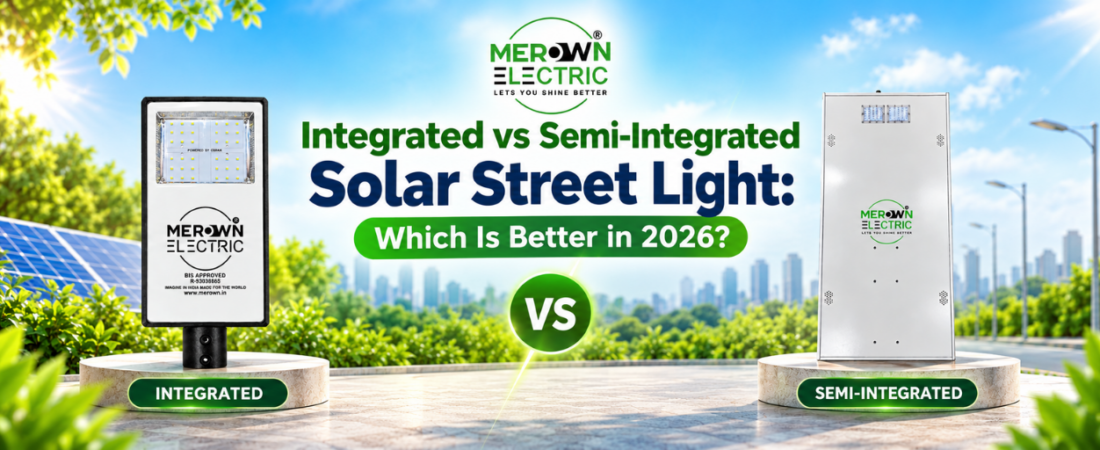
Integrated vs Semi-Integrated Solar Street Light: Which Is Better in 2026?
Choosing the right solar street light is an important decision for residential societies, commercial properties, industrial facilities, public roads and infrastructure projects. In 2026, buyers are looking for energy-efficient lighting, dependable battery performance, convenient installation and long-term value.
Two popular options are integrated solar street lights or All in one solar street light and semi-integrated solar street lights. Although both use solar energy to power LED illumination, they differ in design, solar panel positioning and installation flexibility.
At Merown Electric, we manufacture both configurations to support different project requirements. Understanding their differences can help you choose a lighting solution suited to your location, sunlight availability, illumination needs and budget.
- Discover our Integrated Solar Street Light (All-in-One) range for compact, convenient outdoor lighting.
- Compare configurations and specifications before selecting a model for your project.
1. What Is an Integrated Solar Street Light?
An integrated solar street light, also known as an All-in-One Solar Street Light, combines the solar panel, LED luminaire, battery and charge controller into a compact lighting unit. Depending on the model, it may also include motion sensors and automatic dusk-to-dawn controls.
Its unified construction creates a streamlined appearance and can simplify installation. Since the main components are assembled into one unit, this configuration is often suitable for projects where straightforward mounting and a neat outdoor appearance are important.
Key Features of Integrated Solar Street Lights
- Compact design: Major lighting and energy components are housed in one assembly.
- Convenient installation: The integrated structure can reduce installation complexity.
- Space-efficient construction: A unified design provides a clean appearance on poles and outdoor structures.
- Intelligent lighting options: Selected models support automatic operation, dimming and motion sensors.
- Solar-powered operation: The system uses stored solar energy to power the LED light at night.
Where Are Integrated Solar Street Lights Suitable?
Integrated solar street lights can be considered for residential streets, housing societies, parks, pathways, parking areas, campuses and internal roads. Their suitability depends on the required brightness, pole height, spacing, daily operating hours and expected battery backup.
Buying tip: Do not select an integrated solar street light based on wattage alone. Check the solar panel rating, battery capacity, LED performance, light distribution, backup requirements and protection rating for the specific model.
2. What Is a Semi-Integrated Solar Street Light?
A semi-integrated solar street light combines the LED luminaire, battery and charge controller within the lighting assembly, while the solar panel is installed separately. This arrangement allows the panel to be positioned independently of the light fixture.
Separate panel positioning can be particularly useful when the pole direction, nearby buildings, trees or surrounding structures affect sunlight exposure. The installer can plan the panel orientation to capture suitable sunlight while positioning the light for effective road illumination.
Key Features of Semi-Integrated Solar Street Lights
- Separate solar panel: Allows independent positioning according to site conditions.
- Installation flexibility: Panel orientation can be planned around sunlight exposure and mounting constraints.
- Application-specific sizing: Solar panel and battery capacity can be selected according to project requirements.
- Outdoor versatility: Suitable models can support industrial premises, institutional campuses, village roads and public infrastructure.
- Flexible system configuration: Provides additional options when designing solar energy collection and lighting performance.
Where Are Semi-Integrated Solar Street Lights Suitable?
Semi-integrated solar light models are worth evaluating for industrial facilities, institutional campuses, village roads, public infrastructure, commercial developments and larger outdoor lighting projects where independent panel positioning is beneficial.
However, a separate panel does not automatically guarantee better performance. The actual results depend on panel capacity, orientation, shading, battery storage, LED output, controller efficiency and local weather conditions.
Explore the alternative configuration: View the Semi-Integrated Solar Street Light range from Merown Electric to compare available models and review the specifications relevant to your project.
3. Integrated vs Semi-Integrated Solar Street Light: Key Differences
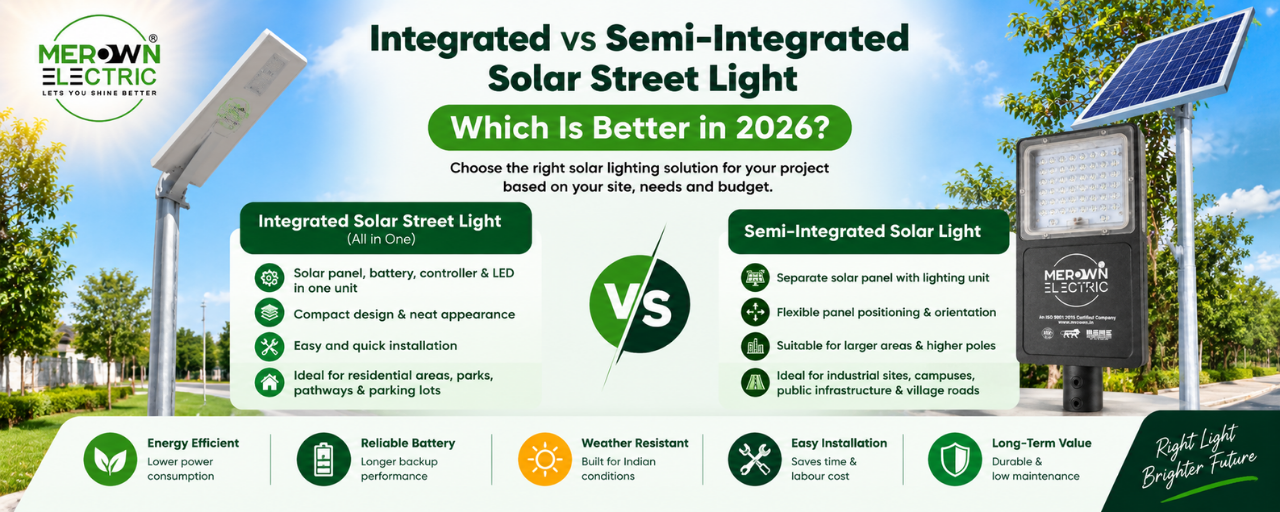
Both configurations use solar energy to operate LED lighting, but their component arrangement and installation approach are different. The following comparison highlights the main factors to consider before purchasing.
| Comparison Factor | Integrated Solar Street Light | Semi-Integrated Solar Street Light |
|---|---|---|
| Design | Major components are combined in one compact unit. | Solar panel is separate from the lighting assembly. |
| Solar panel positioning | Panel orientation is tied to the integrated unit’s installation design. | Panel orientation can be adjusted independently, subject to the mounting design. |
| Installation | Can simplify mounting and reduce separate component installation. | Requires planning for the separate panel and its mounting arrangement. |
| Appearance | Compact and streamlined. | Separate panel and lighting assembly are visible. |
| System sizing | Depends on the specifications of the selected integrated model. | Can offer flexibility in panel placement and project-specific configuration. |
| Potential applications | Residential streets, pathways, parks and suitable parking areas. | Industrial campuses, public roads, institutions and projects requiring flexible panel positioning. |
| Maintenance | Depends on component quality, access and the product design. | Depends on component quality, panel access and the overall installation. |
| Performance | Depends on panel capacity, battery, LED efficiency and controls. | Depends on the same factors, including effective panel placement. |
Which Configuration Offers Better Value?
Integrated solar street lights may offer practical value when convenient installation and a compact structure are priorities. Semi-integrated solar street lights may offer greater design flexibility when panel orientation and site-specific energy collection are important.
Compare the complete system specifications, expected operating performance, installation costs, warranty coverage and maintenance requirements rather than choosing based on the configuration alone.
4. Performance Comparison in Indian Conditions
India experiences varied environmental conditions, including intense summer heat, monsoon rainfall, dust, winter fog and significant regional differences in sunlight. Selecting a suitable solar street light requires considering these conditions alongside the project’s illumination requirements.
4.1 Summer Heat and Battery Performance
During Indian summers, outdoor lighting equipment may be exposed to high ambient temperatures and direct solar radiation. Battery chemistry, thermal management, enclosure design and charging controls all influence the service life and performance of a solar street light.
Both integrated and semi-integrated models can perform reliably when correctly designed for their operating environment. Buyers should verify the battery type, specified operating temperature range, charging limits and manufacturer’s performance documentation.
What Should Buyers Check?
- Battery chemistry and rated capacity.
- Operating temperature and charging specifications.
- Enclosure construction and heat-management design.
- Warranty coverage for the battery and electronic components.
4.2 Monsoon and Reduced Sunlight
Cloudy skies and prolonged rainfall can reduce solar energy generation. During monsoon conditions, performance depends on the balance between available solar charging, stored battery energy and the amount of electricity consumed by the light each night.
An integrated solar street light should have sufficient panel capacity and battery storage for its intended operating schedule. A semi-integrated model offers additional flexibility in panel orientation and, where supported by the product design, panel sizing.
How to Plan for Rainy-Day Backup
Check the stated backup duration, daily lighting hours, charging requirements and any automatic dimming or motion-sensor functions. Backup figures should be evaluated against the manufacturer’s specified operating conditions rather than treated as a guarantee for every weather scenario.
4.3 Dust, Rainfall and Outdoor Durability
Outdoor lighting equipment must withstand dust, moisture, wind exposure and seasonal temperature changes. Both integrated and semi-integrated systems can be suitable when designed with appropriate enclosures, sealed electrical connections and corrosion-resistant mounting hardware.
Essential Durability Checks
- Verify the product’s specified IP rating.
- Check mounting requirements and wind-exposure considerations.
- Review warranty terms and recommended maintenance.
- Confirm that the panel, light fixture and connections are suitable for outdoor use.
4.4 Energy Efficiency and Night-Time Illumination
Energy efficiency depends on LED efficacy, optical distribution, battery capacity, solar panel output and charge-controller performance. Dimming schedules and motion sensors, where available, can help reduce energy consumption and extend operating time.
A compact integrated model may meet the needs of a narrow residential road, while a semi-integrated configuration may be advantageous for a wider road or industrial site requiring more flexible panel placement. The final selection should be based on the required light levels, road width, pole height and spacing.
Important for Indian projects: No single configuration is automatically better in every region. Assess actual sunlight exposure, shading, rainy-season conditions, lighting schedules and the required backup duration before finalising a system.
5. Which Solar Street Light Is Better for Your Project?
The best configuration depends on the installation site, desired illumination, mounting arrangement, budget and maintenance plan. Use the following guide to shortlist suitable options.
Residential Societies and Pathways
Consider an integrated solar street light when a compact design, convenient mounting and a clean appearance are priorities. Confirm that the selected model provides sufficient illumination for the pathway or road.
Parks and Parking Areas
Evaluate integrated models for straightforward installation, while checking pole spacing, light distribution, operating hours and the required level of visibility.
Industrial and Institutional Campuses
Consider semi-integrated models when independent panel positioning helps accommodate buildings, trees, equipment or other site constraints.
Village Roads and Public Infrastructure
Assess both configurations against local sunlight conditions, battery backup, pole height, maintenance access and the project’s operating requirements.
Large Outdoor and Infrastructure Projects
For highways, commercial developments, logistics parks and larger public lighting projects, request a technical assessment before choosing a model. A suitable design should account for the area to be illuminated, road geometry, pole spacing, solar energy generation, battery storage and required lighting levels.
Pre-Purchase Checklist
- Required LED wattage and light distribution.
- Solar panel power rating and orientation.
- Battery chemistry, capacity and backup duration.
- Charge-controller specifications and lighting controls.
- Specified IP rating and operating temperature range.
- Pole height, mounting arrangement and installation cost.
- Warranty, technical support and delivery schedule.
6. Why Choose Merown Electric for Solar Street Lights?
Merown Electric is a solar street light manufacturer based in Noida, India, offering integrated and semi-integrated solar street lighting solutions for residential, commercial, industrial, institutional and infrastructure applications.
By offering both configurations, Merown Electric helps buyers compare suitable product designs according to their project needs instead of limiting the selection to one type of solar street light.
Product Selection for Different Applications
Whether you are planning lighting for a residential development, commercial premises, industrial facility, institutional campus or public infrastructure project, the selection process should begin with the application and required lighting performance.
Local Manufacturing and Project Coordination
As a solar street light manufacturer in Noida, Merown Electric can discuss product requirements, available configurations and technical specifications with customers planning projects in Noida and other locations across India.
Compare Specifications Before Ordering
Before placing an order, confirm the available wattages, battery capacity, solar panel rating, backup duration, protection rating, warranty and delivery schedule for the selected model. These details help establish whether the proposed system meets your project’s requirements.
Working with a manufacturer that offers both integrated and semi-integrated products also allows you to compare the two configurations through one supplier, making product evaluation more convenient.
7. Make the Right Solar Street Light Purchase Decision in 2026
When comparing an All-in-One solar street light with a semi-integrated model, evaluate the complete system rather than focusing on its physical configuration alone. Solar panel capacity, battery quality, LED efficiency, light distribution, weather protection and after-sales support all contribute to long-term value.
Choose Integrated When…
- A compact, unified design is preferred.
- Convenient installation is a priority.
- The available model meets the project’s illumination and backup needs.
- The panel’s installation orientation is suitable for the site.
Choose Semi-Integrated When…
- Independent solar panel positioning is beneficial.
- Site constraints affect sunlight exposure.
- Project-specific panel sizing is available and required.
- The installation can accommodate a separate panel.
Final Verdict: Which Is Better?
An integrated solar street light can be the right choice for projects that prioritise a compact design and convenient installation. A semi-integrated solar street light may be more suitable when flexible solar panel positioning and site-specific system planning are important.
The better option is the one that meets your lighting requirements, available sunlight, battery backup needs, installation constraints and project budget.
8. Frequently Asked Questions
1. What is the main difference between integrated and semi-integrated solar street lights?
An integrated solar street light combines the solar panel, LED fixture, battery and controller in one compact unit. A semi-integrated solar street light uses a separate solar panel, allowing independent panel positioning.
2. Which solar street light is better for Indian weather?
Both configurations can be suitable for Indian weather when properly designed for local temperatures, rainfall, dust and sunlight availability. Compare battery specifications, panel capacity, protection rating and backup performance before choosing.
3. Are integrated solar street lights easier to install?
Integrated models can simplify installation because their main components are combined into one assembly. Actual installation time depends on the mounting arrangement, pole, site access and product design.
4. Why choose a semi-integrated solar street light?
A semi-integrated model allows the solar panel to be positioned independently of the light fixture. This can help improve sunlight exposure when the site layout or mounting direction creates constraints.
5. How many rainy days of battery backup can a solar street light provide?
Backup depends on battery capacity, panel size, LED power, operating hours, lighting controls and weather conditions. Check the manufacturer’s specified backup duration and the conditions under which it is measured.
6. What battery should I look for in a solar street light?
LiFePO4 lithium batteries are used in many solar lighting systems. Compare the battery capacity, rated operating conditions, charging specifications, expected service life and warranty for the selected product.
7. What IP rating should I check for outdoor solar street lights?
Review the specific product’s ingress protection rating to understand its protection against dust and water. Select a rating appropriate for the installation environment and confirm the manufacturer’s specifications.
8. Which solar street light is suitable for industrial areas and public roads?
Both configurations may be suitable, depending on the required illumination, pole height, road width, sunlight exposure, backup requirements and maintenance access. Semi-integrated models may offer additional flexibility in panel positioning.
9. Is Merown Electric a solar street light manufacturer in Noida?
Yes. Merown Electric is based in Noida, India, and offers integrated and semi-integrated solar street lighting solutions. Buyers can contact the company to discuss available models and project requirements.
10. How can I get a quotation from Merown Electric?
Contact Merown Electric with your required wattage, quantity, installation location, pole height, operating schedule and battery backup requirements to discuss suitable products and request a quotation.
Looking for the Right Solar Street Light for Your Project?
Compare integrated and semi-integrated solar street lights from Merown Electric. Our team can help you review available models and identify a suitable configuration for your residential, commercial, industrial or infrastructure project.
Share your project requirements to discuss product specifications, availability and pricing.
Explore Integrated Models Explore Semi-Integrated Models Call Merown Electric: +91 75007 99799Choose the right solar lighting solution for your project with Merown Electric.